… and why we must not let them die – a study and review
My connection with the music of a woman in the late 1800s began with a vintage music livestream…
But first allow me to provide some background and personal context which long precedes this event.
Singing as a volunteer church choir member and cantor for over twenty years (until 2021), I loved assisting my choir leaders in sourcing all sorts of music for our choir to sing – not only for Sunday Masses but many other liturgical celebrations including feast days, ordinations, jubilees, and so on. I was the go-to person for ‘finding music’. I was excellent at it, and have been told that I have a good ear for music.
Where I could, I also enjoyed slipping in the occasional old, lost sacred hymn (mostly in Latin). Bringing these back to life thrilled me. These delightful treasures had not been heard or sung in public at all in our church, and I loved singing them and hearing them played on our old organ for Mass. It seemed like the perfect match.
As a qualified librarian majoring in information and records management, it also gave my skills in research and information retrieval a workout, so it came naturally. When I found a particularly great piece it was like hitting the jackpot!
But you don’t need to be a librarian or even a music lover to appreciate the fact that songs of the past have a special significance to and power over the human soul. The forgotten songs – the unknown, unfamiliar, and dare I say it, even controversial songs – are hidden teachers for us. Why do we fail to listen to them more? What can we learn from them?
They lie everywhere, waiting.
They are dormant in personal and family collections, deceased estates, dusty basements, religious congregations, local markets, attics, boxes, and libraries in every corner of the globe.
Suffocating and stuffed in every nook and cranny. They need to be set free again.
Sheet music once held pride of place wherever there was a piano or organ. It was normal for families and communities to have a piano-forte in the corner of the room at home, in churches, and other public gathering spaces.
There was no television, Netflix, Internet or other screen in front of people, so the piano (and radio) was their entertainment. The piano was the heart and hearth of the family. People laughed, cried, sang, danced, endured hardship, world events, and the milestones of life around their piano.
Old sheet music is charming to see and handle – their fragile, well-worn, and crumbling pages feels like travelling back in time; you have direct contact with the composer’s heart and mind. You access their essence and spirit.
Much of this music has also (thankfully) been digitised for posterity by my colleagues in the library profession across the planet, and they have the most exquisite, artistic covers you will ever see.
In my imagination all of this lost music is just longing to be rediscovered and revived for current and future generations, long after their composers have passed on. When we do so, we honour their memory. There is a secret magic to their songs that cries out: “remember us…”.
It is the month of November as I write this – the month to remember all of the dead. And by sheer coincidence I am publishing this on 11 November 2025 – Remembrance Day. But I don’t really believe in ‘coincidences’ – only God-incidences.
So why should our remembrances also include lost musicians and their music? Why is their work important to us?
Because regardless of where we live in the world, our musical history in sheet music form ought to be preserved and celebrated – not only in film and books.
Nothing permeates the memory and heart like music and singing can. Music is said to be the last thing to ‘go’ (if at all) when we age and begin to lose other memories (perhaps a longer topic for another article I’ll write one day…).
Many of these forgotten pieces inform us about the culture, traditions, values, and the overall human condition at a particular point in time. We learn about the social attitudes of the day (for better or worse), expected behaviours, themes, issues of importance, comedy, satire, and so on. They are a snapshot of how people were and what they thought or believed.
Perhaps we don’t look at them as often as we should because they remind us of what we have lost and need to regain.
But back to that vintage music livestream…
Kylan deGhetaldi (‘foundring’) is a gifted pianist, composer, and ragtime expert. During this vintage music livestream he played ‘Slave Song’ by Teresa Del Riego and happened to mention (at timestamp 3:33:33 interestingly!) that she had written an ‘Ave Maria’.
I believe in little nudges – be it ‘signs’ or ‘confirmations’ – from God.
So once I heard this my alarm bells triggered. What?! An ‘Ave’ I don’t know about!!?? It set me off like the proverbial sniffer dog. I was determined to find this piece and nothing was going to stop me (I am also pretty sure there are other undiscovered ‘Ave’s’ out there waiting for me…)
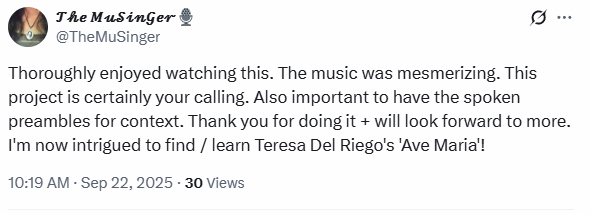

https://x.com/TheMuSinger/status/1969919453669605626
The ‘Ave Maria’ by Teresa Del Riego I have played for you below (organ) has – according to my research and knowledge to date – never been recorded or heard via a public recording before. Apparently it was a great success when performed live at concerts after it was published.
The ‘Ave Maria’ in Latin (‘Hail Mary’ in English) is a common prayer among Catholics, so there is nothing new there, but the interpretation, expression, emotion and notes are new to modern ears. We all know about the popular standard ‘Ave’ settings by Schubert, Gounod, Vavilov, Biebl, etc. – but Riego is unheard of. I thoroughly believe that it – and she – deserves to be up there with the aforementioned composers.
She was a prolific and gifted young female composer in her time, and even seemed to have a connection with admirers / musicians in Australia, which was a pleasant discovery.
Several times while researching Teresa’s life and learning this piece I felt as though I was being helped along the way. A gentle sense of persistence sustained me. Little helps and hints came. I am a self-taught pianist, so it takes me a bit longer to get the music into my fingers, but I was determined to play.
Once I learnt the music in full and could play it through well enough, it was an emotional moment. Hearing the notes breathe again from start to finish teared me up a bit. I felt a sense of relief, but also that Teresa wanted her music to be heard again to honour Our Blessed Mother. I wondered what she thought when she composed it, and what her faith life was like, but that’s a personal question that is not mine to know.
Okay, enough of my rambling… I hope you enjoy this lost and forgotten song.
It is my honour to present ‘Ave Maria’ by Teresa Del Riego (organ) – and subscribe to my new channel for The MuSinGer 😉:
https://rumble.com/v71j4em-ave-maria-by-teresa-del-riego-organ-published-1898.html
Thanks for reading and listening!
Note
For other vintage music check out Foundring’s historical music project and socials. You can follow him on Twitter X at https://x.com/foundring1 and https://substack.com/@foundring. His initial songs from the past playlist can be found at https://x.com/foundring1/status/1910451691822227540 and https://x.com/foundring1/status/1940557320821571738
References
https://en.wikipedia.org/wiki/Teresa_del_Riego
‘La Familia Del Relojero Losada En Londres Teresa Del Riego Y Philip Desborough’ https://dialnet.unirioja.es/metricas/documentos/ARTREV/5802993
‘Teresa Del Riego At Home-Mercury (Hobart, Tas. _ 1860-1954), Tuesday 4 December 1906, page 7’ https://trove.nla.gov.au/newspaper/article/12765304?searchTerm=Teresa%20Del%20Riego#
Pixabay

